Inhaltsverzeichnis
 Related to this topic, the section Moodle contains a selection of interesting pages.
Activities and Materials
In Moodle, various activities and materials can be provided to design collaborative and communicative teaching and learning scenarios in a wide variety of ways. Examination scenarios are also possible. The activity icons are color-coded according to their function within the course. The standard icons use the following colors:
- Purple = Communication
- Pink = Assessment
- Orange = Collaboration
- Teal = Materials
- Brown = Interactive content
Each entry includes a star icon to mark it as a favorite and a help icon to obtain further information.

New features
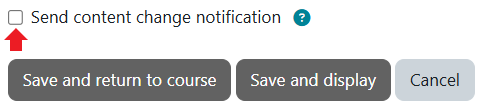 At the very bottom of the settings for all activities and materials, you can select an option to send notifications in the event of content changes.
Activities
An activity is a general term for things that a learner can interactively do in Moodle. Such interactions usually take place within a course—either among learners themselves or between lecturers and learners.
Lecturers can create activities within their courses. In Moodle at Landshut University of Applied Sciences, the following activities are available:
Choice

The Choice activity replaces the classic “raising hands” in face-to-face teaching. Using a Choice, you give students the opportunity to express their opinions or to sign up for specific topics, dates, or decisions.
Possible use cases
- Allocation of presentation topics
- Date polls
- Registration for excursions
- Expression of content-related interests
- Opinion polls: feedback on the course
New features: Common module settings → Force language (Do not force / German / English).
Attendance
to follow
Assignment

With an Assignment, you can set binding tasks for students and collect results online via file upload or text entry, assess them, and provide feedback. Only the lecturer and the respective student have access to the submitted solutions and feedback, unless group submissions are enabled. You can also control the submission period as well as options for single or multiple uploads.
Possible use cases
- Creation/submission of reports
- Submission of presentation slides or group work
- Submission of seminar papers or bachelor’s thesis outlines
New features: It is now possible to configure activity instructions and a time limit.
Questionnaire

This activity allows you to collect information from course participants. Similar to the Feedback activity, surveys can be used to create questionnaires.
Possible use cases
- Feedback at the end of the course
- Feedback on group work processes
- Comprehensibility of questions
New features: A new question type – Slider.

Chat

With the Chat activity, course participants can communicate with each other in real time.
Note: The Moodle chat is designed for use with small groups. Large groups can place a high load on the web servers.
As an alternative, you can integrate the Etherpad Lite activity.
Possible use cases
- Online office hours
- Brainstorming sessions
- Answering organizational and content-related questions
- Introductions
- Virtual consultation hours
- Expert chats
- Individual support
- Pro/con discussions
Database


The Database activity allows you to provide, categorize, and describe files, images, and content/texts. Entries can also be created by students.
Possible use cases
- File exchange for all course participants
- Creation of course session records
New features: This activity was extensively revised with Moodle 4. Further information can be found on the Moodle website Database
Hot Question
 Students have the option to ask questions on various topics such as lectures, learning materials, or exam preparation. They can choose to remain anonymous.
Course facilitators can prioritize questions and, for example, create a list of questions to be addressed in the next session.
Participants can mark up to five questions from other participants as “urgent” to give them additional weight.
Students have the option to ask questions on various topics such as lectures, learning materials, or exam preparation. They can choose to remain anonymous.
Course facilitators can prioritize questions and, for example, create a list of questions to be addressed in the next session.
Participants can mark up to five questions from other participants as “urgent” to give them additional weight.

edu-sharing Object

Etherpad Lite

The Etherpad Lite option provides a synchronous virtual “blackboard” for collaborative text work. The results can be exported afterwards.
Possible use cases
- Joint note-taking
- Revising draft texts
- Brainstorming
External Tool

The External tool allows the use of LTI-compliant learning content and activities from other websites within Moodle. Using this external tool, for example, access can be provided to a new type of activity offered by an external provider.
Further information can be found on the Moodle website External tool
Feedback

The Feedback activity gives students space to provide feedback. Using various question types, you can create a questionnaire and receive direct feedback from participants—also anonymously. This allows supportive measures to be initiated.
Possible use cases
- Feedback on courses
- Assessment of knowledge levels
- Comprehensibility of questions
- Feedback on group work processes (organization, task distribution)
- Interim feedback during different work phases
- Final feedback (after group work and overall)
- Selection of course topics
- Scheduling / finding dates
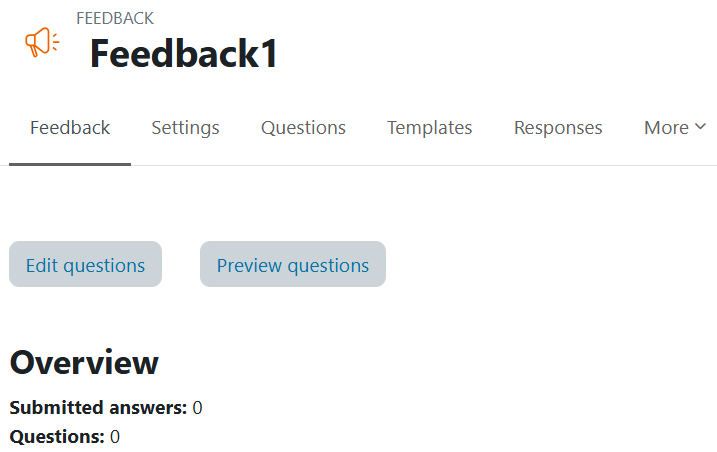
New features: New settings view (functional layout)
Forum

A Forum enables asynchronous communication and organization between lecturers and students, as well as among students themselves. Within different discussion threads, students can read information, respond to questions posed, discuss them, or—depending on the settings—create their own threads and reply to contributions from others.
Possible use cases
- News forum: notice board for the course instructor (organizational matters)
- Collections of questions (FAQs)
- Discussion forum
- Exchange between face-to-face sessions
- Thematic preparation and follow-up of a course
- Exchange during group work
- Provision and exchange of minutes/records
- Questions as collective assignments
- Exam preparation
Special forum type: Announcements
You can use Moodle to send messages to all students enrolled in a course. The forum best suited for this purpose is the Announcements forum, which is available by default in every course. Enrolled participants automatically receive posts from this forum as an email notification. (Guide)
Possible use cases
- Announcing new materials in the course
- Short-notice course information (room changes, cancellations)
- …
Important note: In the Announcements forum, only you as the course instructor have posting rights. Participants have read-only access and cannot reply to your posts. If you want participants to communicate with each other using a forum, you must create the Forum activity (Guide).
Workshop (Peer Assessment)

The Workshop activity allows you to design an assignment that includes self-assessment and/or peer feedback.
Fair Allocation

With the Fair Allocation Gerechte Verteilung activity, you can define multiple options that students can rate to reflect their preferences. Course participants can then be automatically and fairly allocated across the different options.
Possible use cases
- Allocation of presentation topics
- Scheduling processes
- Group allocation
Glossary

The Glossary option allows the provision of definitions as well as the creation and collection of terms, FAQs, etc.
Possible use cases
- Collections of web links, books, or journal references on a topic
- Collaboration
- Vocabulary collections
Group Choice

With the new Group Choice activity, you have a tool that allows students to assign themselves to Moodle groups defined by you through a selection process. After the group choice has been completed, all activities and materials in your course can be worked on in different groups and groupings. This eliminates the need for you to manually assign individual participants to groups.
H5P

Please use the Interactive Content H5P function (black icon, see below). H5P stands for HTML5 Package and allows the creation of content such as interactive videos, quizzes, and presentations.
H5P content can either be stored in the content repository or created on the website h5p.com. These contents can then be added as an H5P activity in a course or embedded into other activities or learning materials.
More information is available on the Moodle website
HotPot

The HotPot activity allows course instructors to manage questions from Hot Potatoes and TexToys via Moodle. The questions are first created on the local computer using a separate program and then uploaded to the Moodle course. After participants complete the test, various reports are available showing how the questions were answered, including statistical evaluations.

Interactive Content H5P

The interactive tool h5p is a free, English-language, web-based open-source tool for creating interactive self-learning materials.
Using the h5p activity, you can create interactive elements directly within Moodle.
Possible use cases
- Independent review of learning progress
- Development of individual learning paths
- Motivation
- Learning activation
Interactive Video Suite

Interactive Video Suite (IVS) – a dynamic video interaction format for lecturers and students.
Transform videos within Moodle into engaging learning formats that promote dialogue. Integrate video-based interactions into your lectures, seminars, or practical exercises.
Lesson

The (complex) Lesson activity allows learning content to be provided in clearly structured and interlinked sections. Students acquire knowledge independently. Learning units can be combined with short quizzes and feedback. Depending on the responses, individual learning paths are offered.
Possible use cases
- Knowledge checks
- Exam preparation: in-depth exploration of specific content
- Interactive textbook replacement
- Development of a lesson accompanying a course
SCORM Package

The SCORM package option allows the integration of individual learning content from other systems in SCORM format.
MATLAB Coding Problem

MediaSite Content

MediaSite is the central video repository at Landshut University of Applied Sciences for finished productions. Videos stored there can be published in Moodle.
Mindmap

Using the Advance Mindmap option, you can structure content, for example during brainstorming sessions.
Possible use cases
- Whiteboard
- Brainstorming
- Lectures and presentations
Scheduler

With the Scheduler, students can book office hour appointments with you online. You can divide your availability into any number of time slots and offer appointments that students can book. Group appointments are also possible.
Possible use cases
- Scheduling office hours
New features: Students can now also add notes to appointments.
Stackviewer
to follow
Student Folder

Using the Student Folder activity, participants can upload documents and files to Moodle, which can be made visible to others by the course instructor. This enables students to publish documents and files in Moodle and improves mutual knowledge exchange.
There is also the option to use an ASSIGNMENT as the basis for the student folder, allowing instructors to decide which documents are visible to everyone or to delegate the approval decision to the participants themselves.
Possible use cases
- Division of labor in group work
- Documentation and presentation of work results
- Knowledge exchange
- Submission of materials
- Creation of a (personal) knowledge pool
Quiz

By providing a Quiz, you can support and assess students’ individual learning progress using created questions. Participants can repeat learning content at any time and test their knowledge. Various question types are available (multiple choice, true/false, short answer, gap fill, matching, etc.). Once created, questions can be reused across multiple quizzes. Using grading scales, you can simulate an exam situation. Grading is carried out automatically.
Possible use cases
- Supportive quizzes (activation, practice, mock exams)
- Knowledge checks (pre-tests or interim tests)
- Preparation and follow-up of courses
- Exam preparation
- Placement tests
Wiki

This activity enables collaborative work on texts: participants can jointly create, expand, and modify the content of wiki pages. Old versions are never deleted and can be restored at any time. Alternatively, you as the course instructor can provide each participant with their own individual wiki.
Possible use cases
- Project management
- Division of labor in group work
- Documentation and presentation of work results
- Brainstorming
- Collections of theses and arguments
- Collaborative creation of tables (Excel alternative)
Learning Materials
Learning materials are resources that you can make available to students. The following functions are available for this purpose:
Book

A book is a learning material that allows multi-page content to be presented in a book-like format. An advantage is that multimedia elements can also be integrated. While it is easy to drag and drop PDF or text files directly onto your course page, adding content directly in Moodle can sometimes be better for accessibility and for mobile learners.
Possible use cases
- Alternative to scripts
- Group work
File

Using the File option, you can provide various file formats (e.g. PDF, Office documents, images).
IMS Content Package

The IMS Content Package learning material is used for preparing and presenting learning content. It can be graphically enhanced and saved in a standardized format, allowing it to be used across different systems without reformatting.
Link/URL

Using the Link/URL option, you can insert links to external websites or documents.
Text and Media Area

Using the Text and media area option (formerly: Text page), you can create texts, subheadings, and assignments directly on the main course page using the Moodle editor. Multimedia elements (images, videos) can also be added.
Page

Using the Page option, you can create and edit a text page in the course using the Moodle editor.
Folder

Using the Folder option, you can manage multiple files within folders and subfolders.